
an honest guide to choosing organic food
fruit without the drama
Soft fruit, grapes and stone fruit earn organic. Banana, citrus and melon do not. The skin decides most of it.
the short version
Regular fruit from the dutch supermarket is safe. EFSA and the NVWA confirm it every year, across tens of thousands of measurements. Buying organic mostly lowers how often a trace of pesticide sits on your fruit, and that only matters for a small part of the shelf.
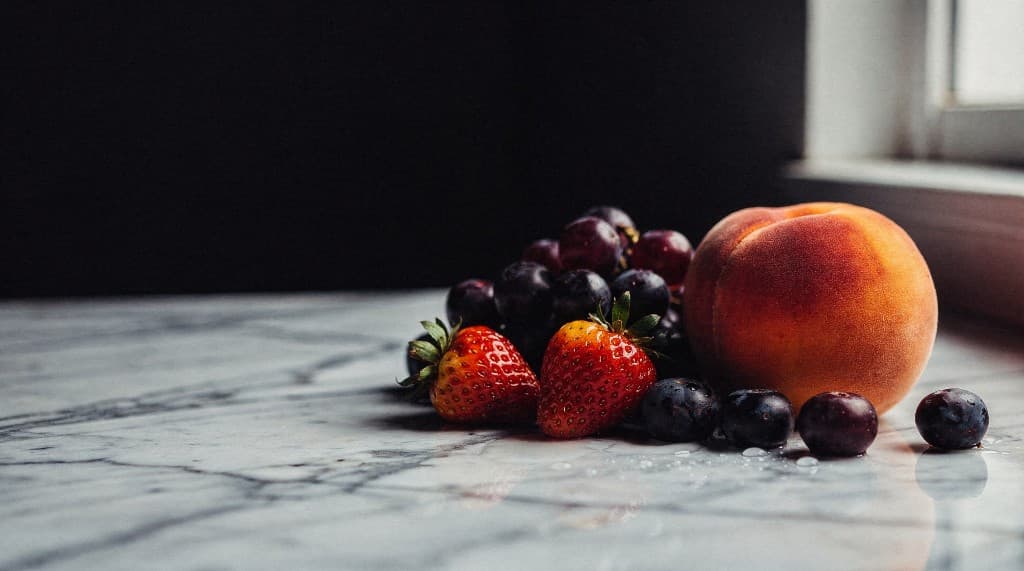
It earns its place with soft fruit and grapes: strawberries, raspberries, blueberries, blackberries, currants, grapes. And with stone fruit: peaches, nectarines, cherries, plums, apricots. When we are on the fence, we lean organic.
It is wasted money on banana, avocado, pineapple, mango, melon and citrus, because you throw the skin away anyway. And the skin decides a lot. You eat a peach with its skin, so it counts there. You can eat a kiwi skin and all and still buy it regular.
The rule of thumb, if you remember one thing: eat the skin, buy organic. lose the skin, buy regular. The one exception is kiwi, low enough to buy regular skin and all.
the honest starting point
There is a lot of noise around organic fruit. One side says regular fruit is drenched in poison. The other says organic is pure marketing. Neither is true, and both are usually trying to sell you something.
The calm version is this. It is not safe against unsafe. It is how often a measurable trace sits on your fruit, and whether that matters for the way you actually eat. For most people the difference is small. For anyone eating large amounts of the same fruit every day, and for young children, it is a little more relevant.
This guide sorts it per fruit, so your money goes where it does something and not where it is just a feeling. The overview first, then the reasoning.
the matrix
| fruit | advice | why |
|---|---|---|
| strawberries | buy organic | heavy spraying, thin fruit, eaten whole |
| raspberries, blackberries, currants | buy organic | same profile as strawberries, nothing removed |
| grapes | buy organic | consistently high in residues, eaten skin and all |
| peaches, nectarines | buy organic | high in residues, skin gets eaten |
| cherries, plums, apricots | buy organic | stone fruit with edible skin, higher in residues |
| apples, pears | buy organic (or regular, peeled) | residues sit on the skin, and most people eat them daily with skin on |
| kiwi | regular, skin and all | naturally low in residues, even when you eat the skin |
| orange, mandarin, lemon, lime | regular is fine | the flesh is clean. using the zest? choose unwaxed or organic |
| banana, avocado, pineapple, mango | regular is fine | you bin the skin, the edible part is clean |
| melon, watermelon, papaya, pomegranate | regular is fine | the rind protects the flesh |
| dried fruit, raisins | buy organic when eaten often | drying concentrates residues. note: mould toxins are not lower in organic |
why regular fruit is safe
EFSA and the NVWA test thousands of fruit samples every year. In the most recent report the vast majority sits within the legal limits, and estimated exposure stays well under the health thresholds. The conclusion is the same every year: low risk to the consumer.
Worth knowing: the legal limit, the MRL, is a trade standard, not a health line. It is set deliberately strict, with a large safety margin underneath it. Thanks to modern equipment a measurable trace is almost always hundreds to thousands of times lower than the amount that does anything. Measurable does not mean harmful.
What regular does do is leave a trace on your fruit more often than organic. For most fruit that changes nothing. For a handful of them it does.
where organic actually earns it
Soft fruit and stone fruit share one profile. The fruit is thin or unprotected, you eat the whole thing, several products often get used on it, and there is no skin to remove that takes the trace with it. Grapes belong in the same group, with the highest residue scores of the lot.
These are exactly the fruits you tend to eat every day, as a snack or in a smoothie, and often the ones children eat most. Whole and often is the combination that makes organic worth it here. Not because regular is unsafe, but because this is where you get the biggest and most consistent drop in residues for your money. On the fruits at the edge, like apples and pears, we lean the same way.
the skin question
Do not assume you peel. More and more people eat the skin of fruit that used to get peeled, and that changes the advice per fruit.
Eat the skin of a peach, nectarine, plum, apple, pear or grape and you are eating the exact part where most of the residue sits. So it counts. Kiwi is the opposite. Kiwi is naturally low, skin included, so you can buy it regular and eat it whole with a clear conscience.
Citrus is its own case. The flesh is clean, so a peeled orange is fine regular. But grate the peel for a recipe and you concentrate the products that sit on that skin. Using zest, choose unwaxed or organic. And with banana, avocado, mango and melon you throw the skin away, so organic there is pure symbolism.
washing and peeling: what actually works
Rinsing under running water removes part of the surface residue. Not all of it, and not the products that have moved into the fruit. For most situations plain water is enough. The evidence for special washes, sodium bicarbonate or vinegar is thin, so you can skip the shopping list.
Peeling removes most of it on fruit where the residue sits on the skin. The catch: that skin holds a lot of the fibre and protective plant compounds. You swap a little less residue for a little less nutrition. On a regular apple, washing it well is often the sensible middle ground.
The most important line in this whole guide: never let fear of residues lower how much fruit you eat. Eating less fruit is a far bigger hit to your health than the residues ever are. Simply eating enough and varied fruit beats the organic versus regular question by a wide margin.
if you want to be stricter
For a few groups, caution is the most defensible. Young children take in relatively more per kilo of body weight. Pregnant women already watch their intake more closely for other reasons. And anyone eating large amounts of one fruit daily, or making a lot of fresh juice and smoothies, raises exposure through sheer volume.
For those groups, organic on the first category, soft fruit, grapes and stone fruit, is a reasonable choice. Reasonable, not required. For the rest of the shelf nothing changes: regular is fine.
the short of it
Buy organic where you eat the fruit whole and often and the skin stays on. That is soft fruit, grapes and stone fruit, plus apples and pears if you eat them daily. Save your money where the skin already does the work, like banana, avocado, citrus and melon. And above all, keep eating fruit. That is the decision that pays off most.
The goal is not a perfect basket. It is a better one.
sources
- EFSA, The 2024 European Union report on pesticide residues in food. EFSA Journal 2026;24(5):e10054. The most recent EU wide monitoring, the low risk conclusion and the residue frequencies.
- EFSA, annual EU reports on pesticide residues in food, 2019 to 2023. Trend data and the three year rotation of tested products, which included grapes, apples, strawberries, peaches, kiwi, pears and oranges.
- NVWA (Netherlands Food and Consumer Product Safety Authority), national residue monitoring and import control results.
- RIVM (National Institute for Public Health and the Environment), dietary and cumulative exposure assessments.
- European Commission, Regulation (EC) No 396/2005 on maximum residue levels of pesticides. The legal basis for the MRL.
- Barański et al., 2014, British Journal of Nutrition. Meta analysis showing a lower frequency of pesticide residues in organic crops.
- Voedingscentrum, "Biologisch". Consumer guidance that organic food is not proven to be healthier than conventional.
- Review literature on ochratoxin A and mycotoxins in dried fruit. The basis for the note that mould toxins are not lower in organic dried fruit.