
Your Sweat Has No Smell
So what exactly are you covering up?
In short
Fresh sweat is close to odourless. The smell is made by bacteria on your skin, hours after the sweat arrives. Which means the standard solution, blocking the sweat, is aimed at the wrong target entirely.
A few things you probably did not know:
- Around 78% of people who are genetically incapable of producing body odour still buy deodorant every day. There is a gene that decides this, and a large share of the population has been buying a solution to a problem they do not have.
- The aluminium cancer scare is not supported by the evidence. We are telling you this even though we sell an aluminium-free product. Here is why we still think antiperspirants are the wrong tool.
- If your last natural deodorant failed, week one was probably the reason. Your armpit microbiome reorganises when you stop using antiperspirant, and you can smell worse before you smell better. Almost nobody is warned about this, so almost everybody quits on day four.
- Two people can eat the same food, train the same way, and smell completely different. It comes down to the ratio of two bacterial genera living on your skin.
Then: what a modern natural deodorant actually has to do, what we put in ours, and how to switch without giving up in week one.
1. The armpit is doing more than you think
The axilla is a small patch of skin carrying an unusually heavy workload.
It is a thermoregulation site. Eccrine glands, the ones spread across most of your body, produce watery sweat that evaporates and pulls heat off you. When you are running in July, this is not a nuisance. This is the system that keeps your core temperature survivable.
It is a lymph node junction. The axilla holds one of the largest clusters of lymph nodes in the body, which makes it an immunologically busy and structurally delicate zone. Worth being precise here, because a lot of marketing gets this wrong: those nodes are immune surveillance, not a drain for waste. Nothing is "released" through your armpit skin.
It is an apocrine zone. Apocrine glands, concentrated in the armpits and groin, switch on at puberty and secrete a richer, protein-heavy fluid into the hair follicle. This fluid is the raw material for body odour, and it is odourless when it leaves you.
And it is a microbiome. A dense, specific bacterial community lives there, shaped by the warmth, the moisture, and the food supply.
Now consider what this skin puts up with. It is folded, so it is occluded and holds heat. It loses water faster than the skin on your forearm. It gets shaved, which is a controlled injury to the skin barrier. It rubs against fabric all day. And on top of all that, most adults apply a product to it every single morning, often within minutes of shaving it, for fifty or sixty years running.
It is one of the most abused patches of skin on the human body, and almost nobody knows what they are putting on it.
2. The bacteria do the smelling, not you
The chemistry here is genuinely interesting, and it matters for everything that follows.
Apocrine glands secrete odourless precursor molecules. Skin bacteria then break them apart, releasing volatile compounds. There are two main routes.
The onion route. Staphylococcus hominis takes up a precursor called Cys-Gly-3M3SH, cuts it with a dipeptidase and a C-S-lyase, and liberates a thioalcohol: 3-methyl-3-sulfanylhexan-1-ol. Sulphurous, oniony, and detectable by the human nose at extraordinarily low concentrations. Notably, not every staph species can do this. S. hominis, S. haemolyticus and S. lugdunensis are efficient producers. S. epidermidis is not.
The sour route. Corynebacterium species use a zinc-dependent enzyme to release fatty acids: 3-methyl-2-hexenoic acid and 3-hydroxy-3-methylhexanoic acid. Sour, tangy, faintly goat-like.
Your personal odour signature is a blend of these two routes, and which one dominates depends on the ratio of Staphylococcus to Corynebacterium on your skin. Which is why two people can eat the same food, do the same training, and smell entirely different.
The people who never needed deodorant
There is a single-letter variation in a gene called ABCC11 that decides whether the apocrine transporter works at all. If you carry two copies of the A variant, the transporter is non-functional. You have dry earwax, and you produce essentially no body odour. This variant is common in East Asian populations and rare in Europeans.
Here is the part that says something about all of us. In a large UK cohort study, researchers matched genotype against deodorant use. Genotype predicted usage strongly, as you would expect. But 77.8% of the genetically odourless participants were still buying and applying deodorant every day, out of pure habit.
The takeaway: odour is a bacterial output, not a sweat output. So the intelligent place to intervene is the bacteria and the molecules they produce. Not the sweat.
3. So why does the standard product block the sweat?
This is where the category splits, and the distinction is not cosmetic.
A deodorant targets smell. An antiperspirant reduces sweat. They are different products doing different things, and in the United States the difference is formal: an antiperspirant is regulated as an over-the-counter drug, because it deliberately alters a bodily function.
What an antiperspirant physically does
Aluminium salts hydrolyse near the top of the sweat duct and form positively charged polymeric species. These bind sweat proteins and duct-wall keratin, aggregate, and form a gel plug that physically blocks the pore. Microfluidic imaging has watched this happen in real time: the blockage builds from the walls of the duct inward.
It works. It is also, said plainly, a structural intervention. You are installing a plug in a functioning gland to solve a problem that gland did not cause.
Let us be honest about the safety question
Cheechaa is not going to sell you anything using fear, so here is the actual state of the evidence.
The breast cancer link is not supported. The US National Cancer Institute states there is no scientific evidence connecting antiperspirant use to breast cancer. A 2023 systematic review across six incidence studies found no consistent association. The American Cancer Society says the same.
The Alzheimer's link is not supported. The WHO concluded as far back as 1997 that aluminium is not a causal factor. Elevated aluminium in affected brain tissue appears to be a downstream finding, not a cause.
Skin absorption is minimal. The EU's Scientific Committee on Consumer Safety assessed dermal bioavailability at 0.00052% and concluded that cosmetic aluminium does not meaningfully add to total body burden. The Dutch RIVM reached the same conclusion in 2020: aluminium from skin products barely penetrates, and total exposure sits well below the health-based limit. Your dietary aluminium, from grains, tea and cocoa, dwarfs anything a deodorant contributes.
We are telling you this because a brand that needs to frighten you is a brand with a weak product.
The objections that do hold up
So why avoid it? Four reasons, all defensible.
One: it is a category error. You are switching off local thermoregulation to fix a smell that sweat does not cause. If you train, if you spend time in heat, if you care about how your body regulates itself, deliberately disabling a working system is a strange trade for a cosmetic outcome.
Two: it changes the microbiome. A 2016 study following participants through starting and stopping antiperspirant found real shifts in bacterial community composition. The authors were careful not to claim one profile is "healthier", and neither will we. But you are absolutely changing the ecosystem.
Three: irritation. Occluded, shaved, product-loaded skin reacts. Plenty of people simply do not tolerate it.
Four: the shaved-skin caveat. Germany's BfR advised against applying aluminium antiperspirants directly after shaving or onto broken skin, since absorption through a compromised barrier is higher. The later SCCS opinion considered this negligible. It is an unresolved nuance rather than a proven danger, but it costs nothing to take seriously.
None of that is a health scare. It is a design argument: this is a heavy-handed tool for a light problem.
4. Why natural deodorant earned its bad reputation
If you have tried natural deodorant before and gone back, you were not imagining it. The category was, for a long time, badly built.
It smelled worse before it smelled better. When you stop using an antiperspirant, your armpit microbiome reorganises. For one to two weeks, you can smell worse than you did before. Almost nobody is warned about this, so almost everybody quits on day four and concludes natural deodorant does not work. This is the single largest cause of failed switches, and it is not a product failure at all.
The alkaline systems were crude. Most natural deodorants relied on one alkaline ingredient at high load, thrown into a bare oil base. Raising the surface pH does suppress odour bacteria, but skin sits at pH 4.5 to 5.5 for a reason, and pushing it several units higher every morning with nothing to buffer it and nothing to repair the skin afterwards degrades the barrier. The result is irritant contact dermatitis: redness, itching, burning, and on deeper skin tones, lingering pigmentation. The problem was never the concept. It was dose, balance, and the total absence of any care layer.
They were under-engineered. Half the products on the shelf were starch and oil in a tin. Starch absorbs moisture but does nothing to odour. That is a moisturiser with a marketing claim.
They leaned on allergens while claiming to be gentle. "Natural fragrance" usually means essential oils, and essential oils are where the regulated fragrance allergens live: limonene, linalool, citral, geraniol. Tea tree oil becomes a potent sensitiser once its terpenes oxidise. A heavily essential-oiled natural deodorant can carry a higher allergen load than a plain synthetic one. The EU expanded its mandatory allergen labelling list to over eighty substances under Regulation 2023/1545, phasing in through 2028, which tells you how seriously this is taken. What matters is not whether a product contains essential oils, but at what concentration, and whether the allergens are declared.
And they sold stories instead of mechanisms. Probiotic and prebiotic deodorants promise to "rebalance your microbiome". The mechanism is plausible. The clinical evidence is one small trial in ten patients with a diagnosed condition, using bacteria in saline rather than a commercial product. Chris Callewaert, who has done more work on the armpit microbiome than almost anyone, describes the field as early days. Treat those claims as a hypothesis, not a feature.
Also, and the industry does not admit this often enough: most of them smelled like a health food shop. Worthy, herbal, faintly damp. You cannot ask someone to give up a product that works on the promise of a product that does not, and then hand them something that smells like sincerity.
The category was not wrong. It was unfinished.
5. What a modern natural deodorant has to do
Four jobs. A serious formula does several at once, because no single mechanism is strong enough alone.
| Job | How it works | What does it |
|---|---|---|
| Slow the bacteria | Reduce the population producing odour compounds | Lauric acid from coconut oil, zinc oxide |
| Neutralise the odour | Shift surface conditions so volatile acids cannot persist | A buffered alkaline system |
| Absorb moisture | Manage dampness without blocking the gland | Arrowroot starch |
| Repair the skin | Because this is the fold you shave every week | Shea butter, vitamin E, a nourishing base |
That last row is the one the category kept skipping, and it is the reason so many natural deodorants irritated people. An active system with nothing to look after the skin is a formula with a hole in it.
Two more things separate a serious formula from a hopeful one.
An anhydrous base. A water-free balm needs little or no preservative, because there is no water for microbes to grow in. It also carries far more active ingredient per gram than a water-based roll-on. If you see a water-containing product marketed as preservative-free, that is a red flag, not a feature.
A fragrance that was actually designed. Not an essential oil dropped in at the end, but a composed profile at a controlled, declared allergen load. Something you would wear on purpose.
6. BAUME AXILLAIRE
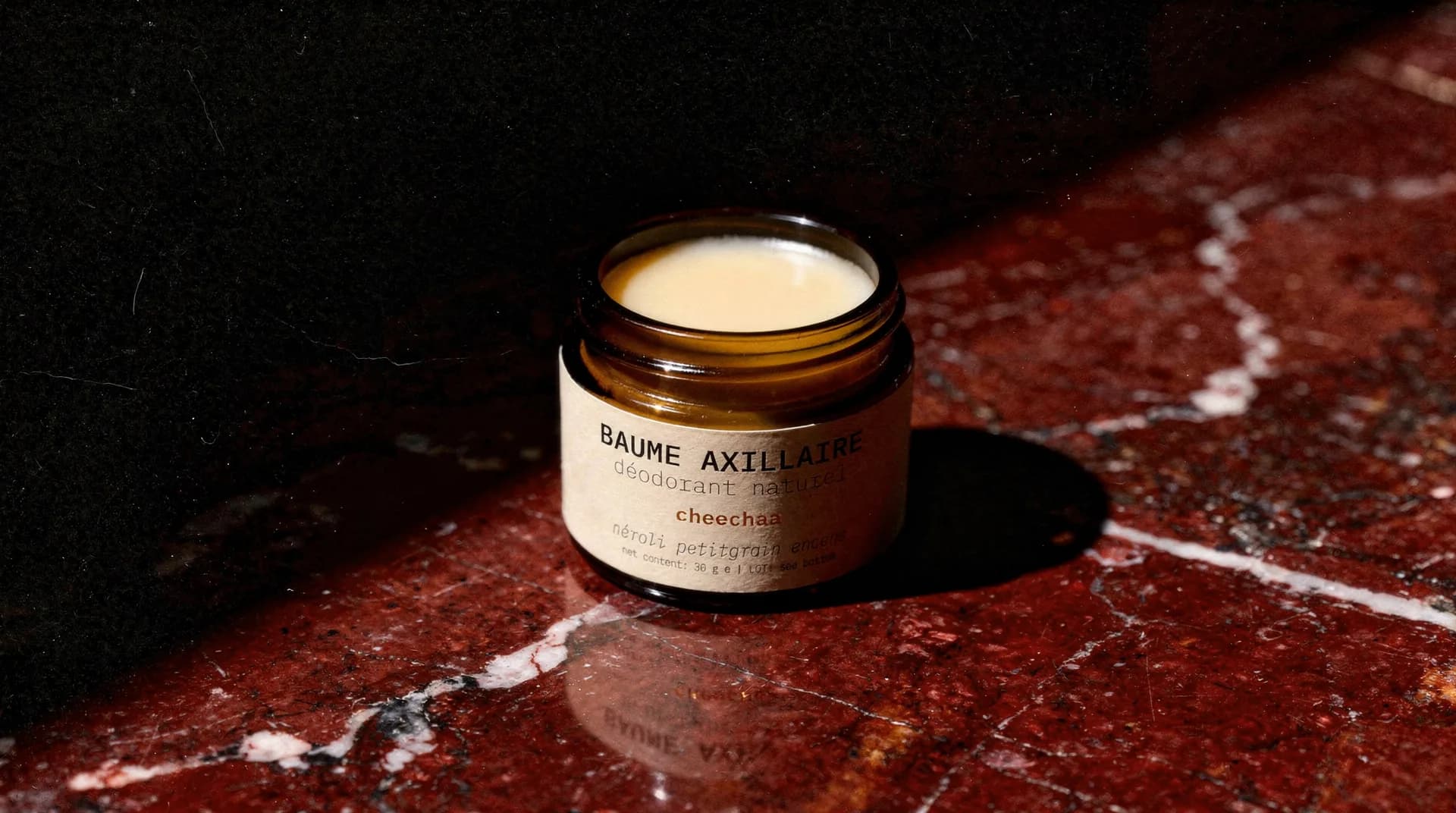
This is the product we built against the list above.
No aluminium salts. Not because we think they cause cancer, because the evidence says they do not, but because plugging a working gland to solve a bacterial problem is bad engineering.
A buffered alkaline system, not a blunt one. Sodium bicarbonate paired with magnesium hydroxide, which is a considerably milder base. The pairing does the odour-neutralising work without leaning on a single aggressive ingredient to carry the entire formula.
Zinc oxide, non-nano. Mildly antibacterial and absorbent, sitting on the surface rather than being driven into it.
Coconut oil at close to half the formula. It is the base, and it is not inert: lauric acid contributes antibacterial activity, so the carrier is doing work rather than just holding everything together.
Arrowroot for moisture, not for blocking. It manages dampness while the gland keeps functioning.
Shea butter and vitamin E. Because armpit skin is skin, and this is the fold you shave. The care layer is part of the design, not an afterthought.
Anhydrous, so essentially no preservative load. Water-free, higher active concentration, and a balm texture that sinks in rather than sitting on the surface.
Fragrance treated as the point, not the apology. Three compositions, each built on neroli, each going somewhere different:
- Néroli, Petitgrain, Encens. Bright, green and resinous. The cleanest and most classical of the three.
- Néroli, Cardamome, Vétiver. Warm spice over a dry, earthy root. The most grounded.
- Néroli, Santal, Coriandre. Soft, woody and faintly sweet. The quietest of the three.
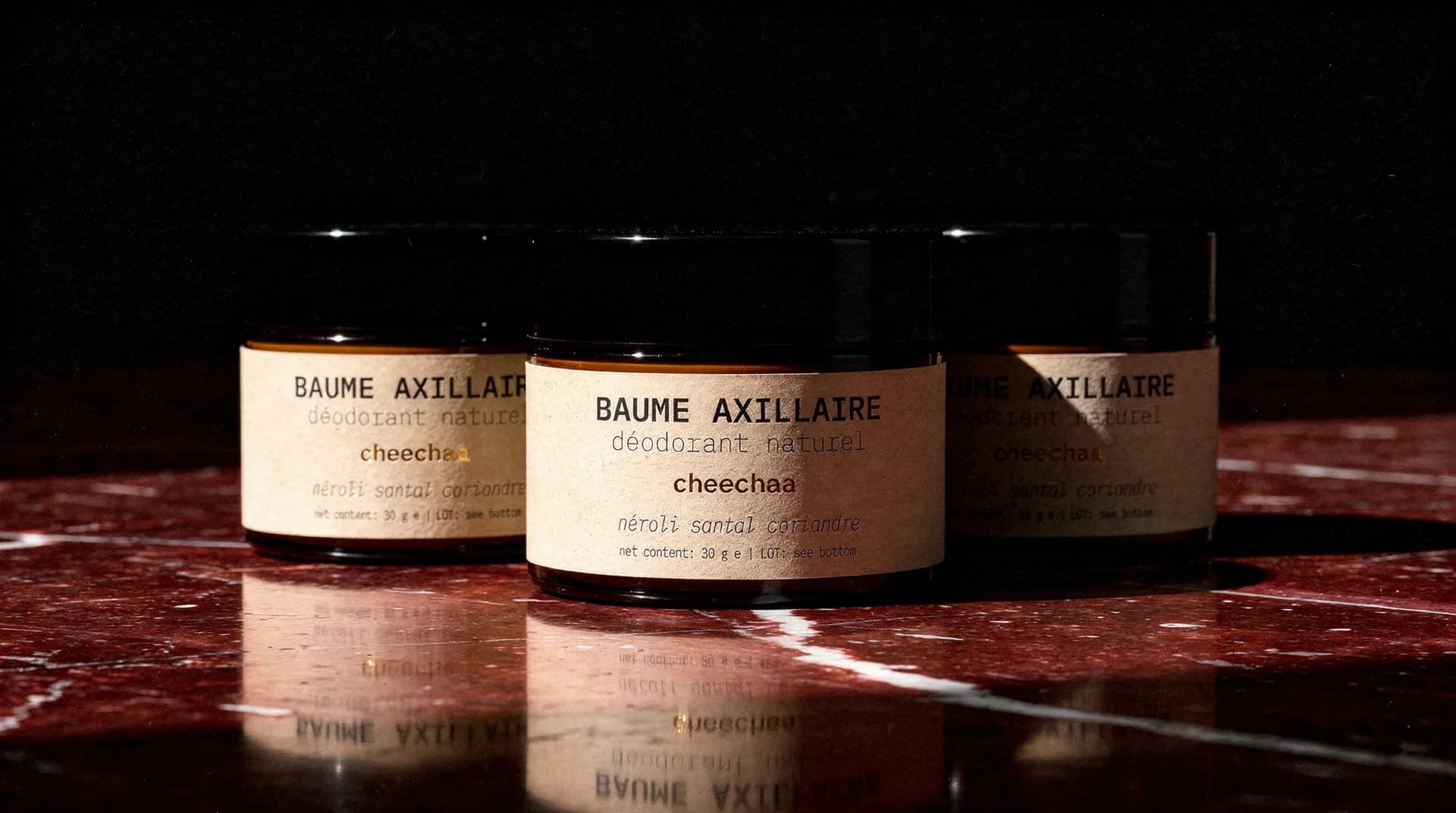
Total essential oil load sits at roughly 0.3%, and every regulated fragrance allergen is declared on the pack.
See all three BAUME AXILLAIRE variants →
One honest note on sensitivity
This is an effective formula, and effective formulas are not invisible. If your skin is reactive, if you have eczema, or if a previous natural deodorant left you red and itchy, patch test on your inner forearm for 48 hours before you commit to daily use, and do not apply straight after shaving. Most people are fine. Some people are not, and we would rather tell you now than have you find out on day ten.
7. How to switch, properly
Most failed transitions are procedural, not chemical.
Give it two weeks. Your microbiome is reorganising. You may smell worse in week one. This is the single most common point of abandonment, and it passes.
Use less than you think. A thin layer. More product does not mean more protection, it means more residue and more irritation risk.
Not straight after shaving. Apply in the evening, or wait a few hours. Freshly shaved skin is compromised skin.
Patch test first. Inner forearm, 24 to 48 hours, before you commit it to a daily routine.
Reapply when you need to. A deodorant is not an antiperspirant. On a hot day or after training, a second application is normal, not a failure.
Stop if it burns. Persistent redness, itching or stinging is not "adjusting". That is irritation. Stop, let the skin recover, and rethink.
When we would tell you to buy something else
If your actual problem is wetness, not smell, no natural deodorant will fix it. Get an antiperspirant. It is safe at normal use, and it is the right tool for that job.
If sweating disrupts your daily life, that may be hyperhidrosis, and it has real clinical treatments: prescription aluminium chloride, iontophoresis, botulinum toxin, microwave thermolysis. Go to a doctor, not a shop.
If you have persistent strong odour despite washing, or a fishy odour that no product touches, see a physician. Bromhidrosis and trimethylaminuria are medical conditions, and nothing on our shelf will help you.
The short version
Your sweat does not smell. Bacteria acting on it do. An antiperspirant answers this by plugging the gland, which works, and which is a heavier intervention than the problem requires. Natural deodorant is the correct approach, and it spent twenty years being badly executed: crude alkaline systems, no skin care, no fragrance worth wearing, and too much willingness to sell a story instead of a mechanism.
BAUME AXILLAIRE is what the category should have been.
Sources
- Scientific Committee on Consumer Safety (SCCS), Opinion on the safety of aluminium in cosmetic products, Submission II, SCCS/1613/19
- SCCS, Addendum to the Opinion on aluminium, SCCS/1626/20
- RIVM, Human health risk assessment of aluminium, Report 2020-0001
- RIVM, Total aluminium exposure not harmful to health
- EFSA, Safety of aluminium from dietary intake
- Bundesinstitut für Risikobewertung (BfR), Aluminium-containing antiperspirants contribute to aluminium intake
- National Cancer Institute, Antiperspirants/Deodorants and Breast Cancer
- Moussaron A. et al., Correlation between daily life aluminium exposure and breast cancer risk: a systematic review, Journal of Trace Elements in Medicine and Biology, 2023
- Allam M.F., Breast Cancer and Deodorants/Antiperspirants: a Systematic Review, Central European Journal of Public Health, 2016
- Alzheimer's Research UK, Aluminium and Alzheimer's: an unproven link
- Bawdon D. et al., Identification of axillary Staphylococcus sp. involved in the production of 3-methyl-3-sulfanylhexan-1-ol, FEMS Microbiology Letters, 2015
- Rudden M. et al., The molecular basis of thioalcohol production in human body odour, Scientific Reports, 2020
- James A.G. et al., Microbiological and biochemical origins of human axillary odour, FEMS Microbiology Ecology, 2013
- Rodriguez S. et al., Dependence of deodorant usage on ABCC11 genotype, Journal of Investigative Dermatology, 2013
- Urban J., Fergus D.J., Savage A.M. et al., The effect of habitual and experimental antiperspirant and deodorant product use on the armpit microbiome, PeerJ, 2016
- Real time observation of the interaction between aluminium salts and sweat under microfluidic conditions, Scientific Reports, 2021
- Regulation (EU) 2023/1545 on fragrance allergen labelling, amending Regulation (EC) No 1223/2009
- Chen Y. et al., Treatment of axillary osmidrosis by rebalancing skin microecology with Lactobacillus bulgaricus, Frontiers in Microbiology, 2022
- International Hyperhidrosis Society, Clinical Guidelines
- US FDA, Is It a Cosmetic, a Drug, or Both?
- Popular Science, Do probiotic deodorants really work? (interview with Chris Callewaert)